


1. Introduction: The Threat of Cryptographically Relevant Quantum Computers (CRQC)
A Cryptographically Relevant Quantum Computer (CRQC) represents a generational leap in computational capability, specifically one possessing enough stable, error-corrected qubits to execute Shor’s algorithm at a scale that breaks modern public-key infrastructure. Assessing the timeline for CRQC emergence is obstructed by an “information distortion” problem: corporate actors have an incentive to inflate progress to secure venture capital, while sovereign states treat quantum milestones as classified strategic assets.
To mitigate this uncertainty, the Bitcoin Honeypot Address Protocol (BHAP) establishes a “quantum bounty”—an economic incentive designed to force a CRQC operator to reveal their capabilities. By utilizing a weakened elliptic curve within a standard-looking Bitcoin Taproot address, the BHAP acts as an early warning system. If the funds are moved, it signals that the Elliptic Curve Discrete Logarithm Problem (ECDLP) has been solved on a reduced bit-length, providing the global community an alert before production-grade curves like secp256k1 are compromised.
2. The Security Delta: 128-bit vs. 96-bit Security
The BHAP architecture relies on the security differential between the standard Bitcoin curve and a deliberately weakened honeypot curve. Bitcoin’s security is uses secp256k1, while the honeypot utilizes secp192r1 to lower the quantum barrier while maintaining a technically significant threshold.
| Parameter | Standard (secp256k1) |
Weakened (secp192r1) |
|---|---|---|
| Bit-Security | 128-bit | 96-bit |
| Field Size | 256-bit | 192-bit |
| Purpose | Mainnet Security | Quantum Early Warning (Honeypot) |
Current research provides a wide variance in qubit requirements for breaking standard 128-bit security. Estimates from the University of Sussex suggest that breaking secp256k1 within an 8-hour window requires between 13 million and 300 million physical qubits. Webber et al. estimate approximately 317 million physical qubits for a 1-hour attack, scaling down to 13 million qubits if the attacker can afford a 24-hour window. Logical qubit requirements are estimated to be between 1,500 and 3,000. By weakening the curve to 96 bits, the BHAP target becomes achievable for a CRQC that is several technological iterations away from threatening the 128-bit curve.
3. The BHAP Distributed Protocol
The protocol involves n Participants and a Coordinator. The implementation leverages some python libraries Python: secrets for entropy, coincurve and tinyec for elliptic curve operations, cryptography for ECIES, and bitcoinutils for Taproot construction.
The following naming conventions apply:
- (, ): (Public, Private) keys on the
secp256k1curve. - (, ): (Public, Private) keys on the
secp192r1curve.
3.1 Phase 1 & 2: Key Generation and Public Key Aggregation
Each participant i uses the secrets and bitcoinutils libraries to generate a random and its corresponding public key on secp256k1.
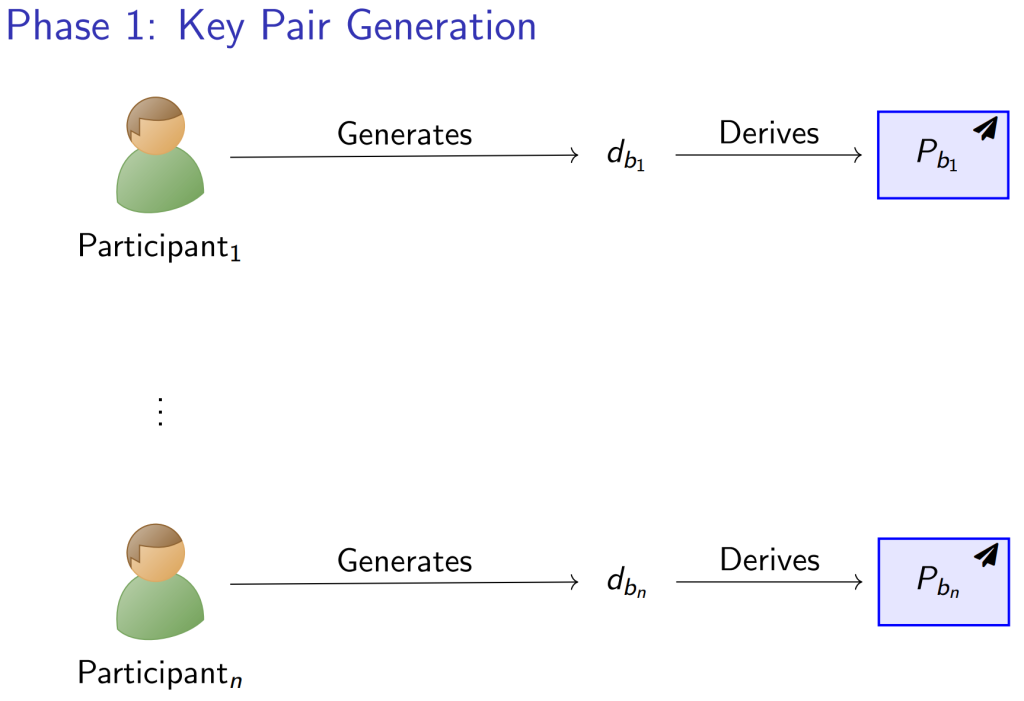
These are shared with the coordinator, who aggregates them using the coincurve library:
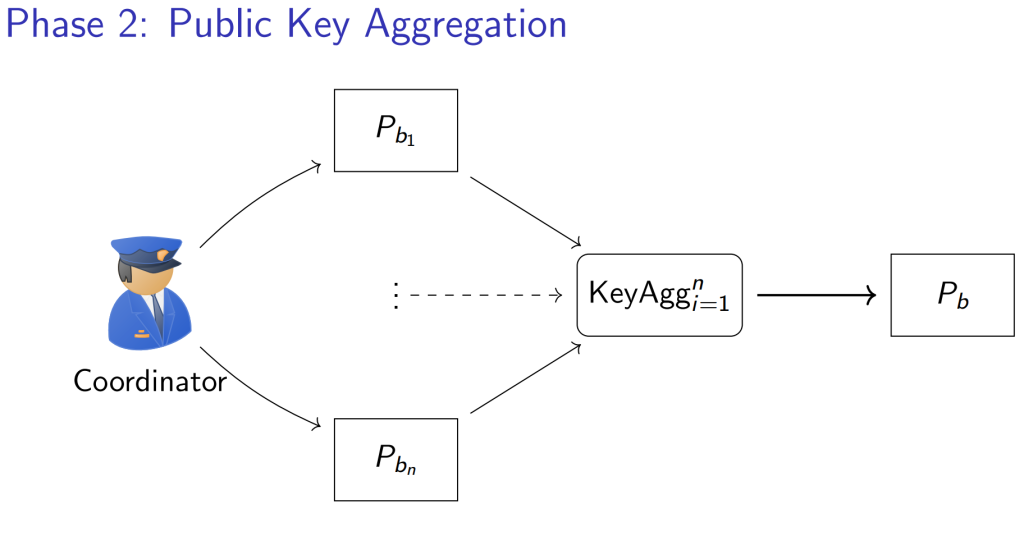
This aggregation uses EC point addition.
Note: The coordinator must verify that is not a trivial point, specifically checking that it is not the Point at Infinity (O) or the Generator (G). If a trivial point is reached, the protocol must be restarted to prevent a compromised or zeroed master private key.
3.2 Phase 3: Weaker Key Derivation (secp192r1)
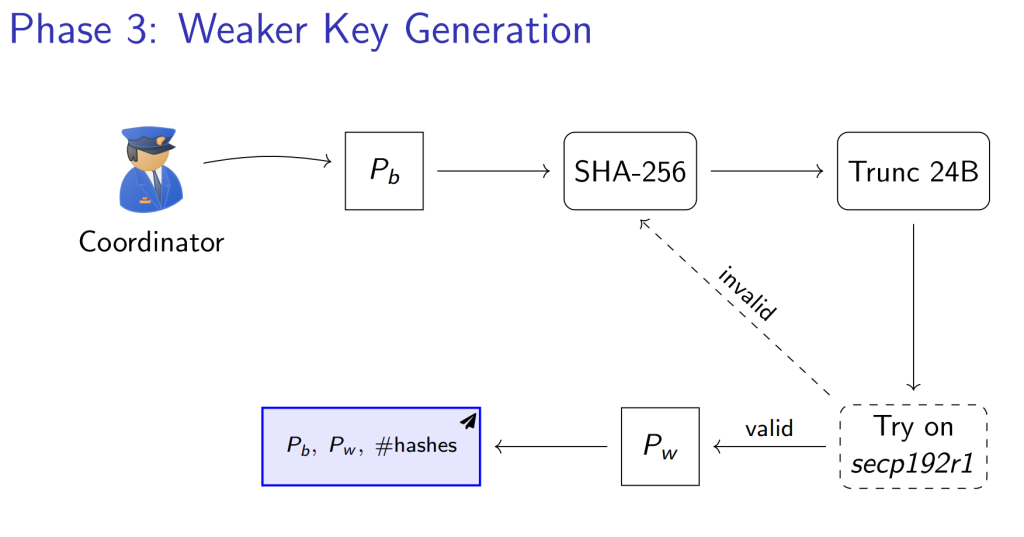
The coordinator derives the weak key from through iterative hashing. The is hashed via SHA-256 and truncated to the most significant 24 bytes (192 bits), matching the field size of secp192r1. This 24-byte value serves as a candidate x-coordinate. If the value does not yield a valid point (i.e., it is not a quadratic residue), the coordinator increments a counter and hashes the previous result again.
Once a valid is found using tinyec, the coordinator shares , , and the hash count. This allows participants to verify the derivation of from before proceeding, ensuring the weakened key is not arbitrarily selected.
3.3 Phase 4: ECIES Encryption of Private Keys
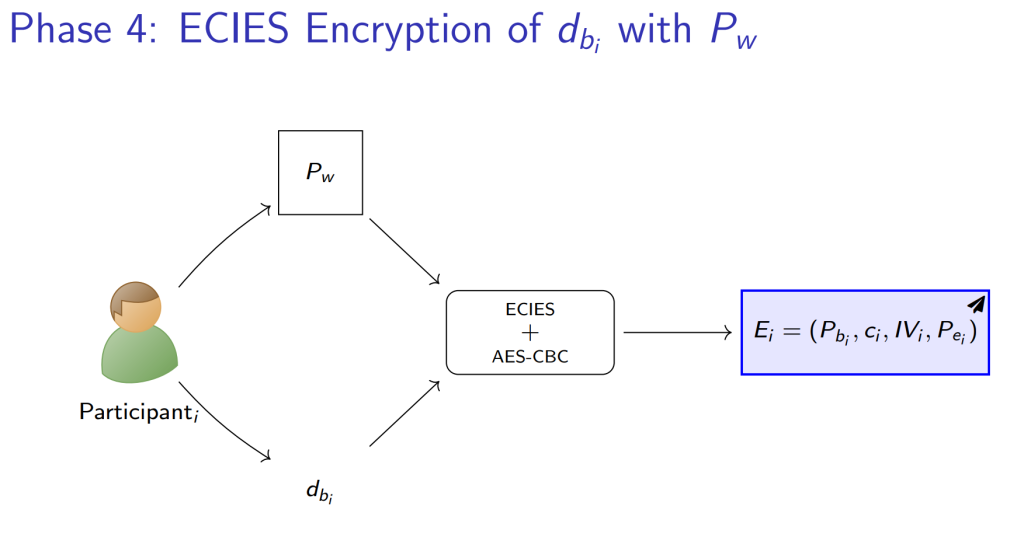
Using as the encryption key, participants encrypt their using ECIES. The protocol utilizes AES-CBC for the symmetric cipher component.
Note: AES-CBC was chosen over the more modern AES-GCM to minimize the data footprint for IPFS and on-chain commitments. Since an authentic communication channel is assumed between participants and the coordinator, the additional authentication tag provided by GCM is redundant.
The output for each participant is where is the ciphertext, is the Initialization Vector, and is the ephemeral public key generated during the ECIES handshake.
To prevent a Denial of Service attack where a malicious participant submits “garbage” data that breaks the final reconstruction, future iterations of the protocol will mandate Zero-Knowledge Proofs to prove contains a valid corresponding to .
3.4 Phase 5: Taproot Commitment and Funding
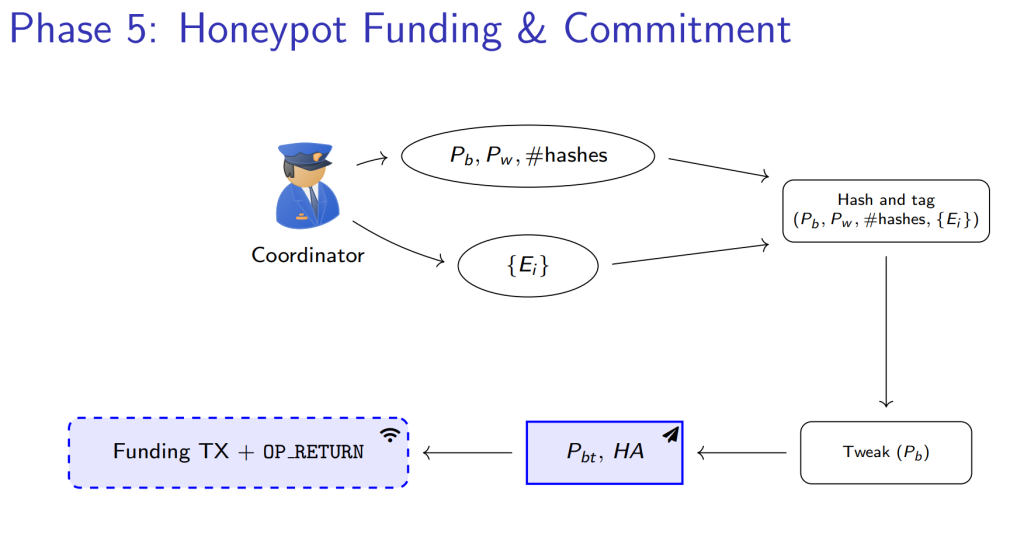
The coordinator collects all and the key derivation data. Then uses Tagged Hashes to create a commitment of all protocol data. This hash is used as a Taproot tweak to transform into the tweaked public key:
The is converted into the Honeypot Address (HA). The funding transaction includes an OP_RETURN output with an IPFS link containing the full commitment data and the implementation source code.
4. The Redemption Process: Shor’s Algorithm attacker
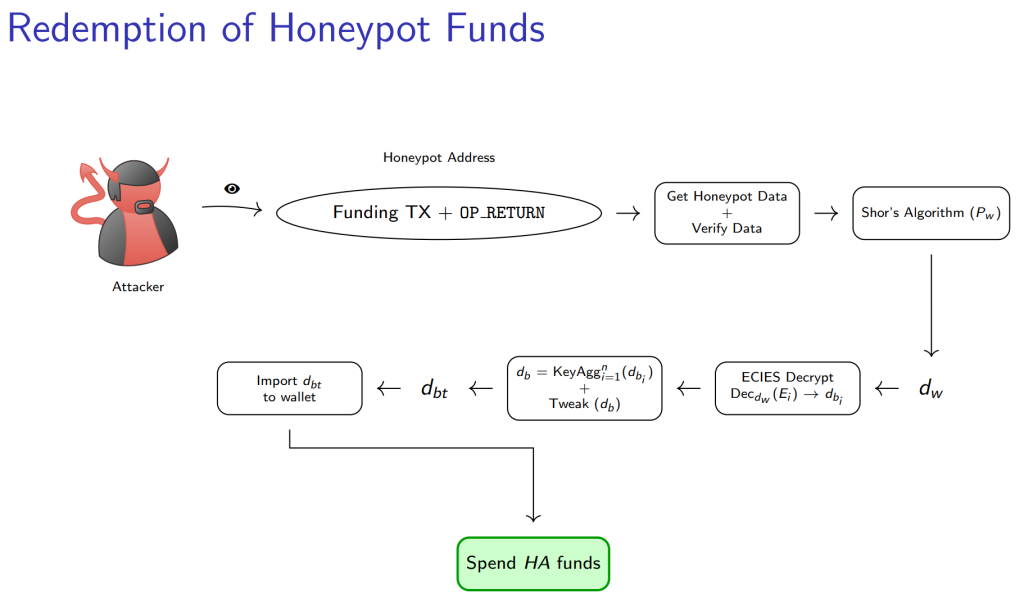
A supposedly quantum attacker retrieves the IPFS metadata and follows this flow to claim the bounty:
- Verification: The attacker recomputes the tagged hash and the tweak of to ensure HA matches the published data, confirming no “bait” occurred.
- Quantum Attack: The attacker executes Shor’s algorithm to solve the ECDLP for the weak public key , obtaining the weak private key .
- Decryption: Using , the attacker retrieves and from each in the IPFS metadata. They perform ECIES decryption to recover each participant’s private key .
- Reconstruction: The attacker aggregates the recovered keys to find the master private key: (or ).
- Claiming Funds: The attacker applies the Taproot tweak to to obtain the tweaked private key . This key allows the attacker to sign a valid Schnorr signature to spend the funds from the HA.
5. Protocol Properties & Security Analysis
- Compatibility: The HA is indistinguishable from standard P2TR (Pay-to-Taproot) addresses, ensuring the honeypot is fully compatible with Bitcoin.
- Correctness: If participants provide valid data, any entity capable of breaking
secp192r1is mathematically guaranteed to recover . - Robustness: remains unknown as long as at least one participant is honest. No participant, including the coordinator, can access the funds without access to a CRQC or the collusion of all other participants.
- Verifiability: Every step—from the iterative hashing of to the Taproot tweaking—is publicly auditable via the IPFS data.
6. Conclusion
BHAP provides a practical solution to quantum uncertainty. By converting the abstract threat of a CRQC into a tangible financial incentive, we create a “quantum canary” that forces the disclosure of advanced capabilities.
Future work focuses on the full integration of Zero-Knowledge Proofs during Phase 4 to ensure protocol integrity against malicious participants.